The cut was approved on Friday. On Monday, someone wants the second voiceover line changed and a vertical version for social. You can still edit an MP4: crop it, cut it, replace a section or cover existing pixels. The harder question is whether you can make those changes without reconstructing the work underneath.
An editable project preserves the pieces you may need to change: shots, text, audio stems and timing. For AI-generated shots, prompts and references are useful source material too. This guide gives you four checks for a tool's handoff, plus a small After Effects test showing what a targeted revision looks like.
Jump to: our revision test · what to preserve · four checks · Voyager's scope
What a rendered file throws away
A finished video is pixels and a soundtrack. The rendered file does not retain the project structure: where one shot ends and the next begins, the script, the timing decisions, the source generations, the music separate from the voice, the captions as text instead of burned-in shapes. Editors have a word for the thing that keeps all of that: a project. A project is references plus decisions. The clips point at media; the timeline records what was chosen. The render is what you make from a project when you are done deciding.
The clearest statement of the distinction comes from OpenTimelineIO, the open interchange format the film industry uses to move edits between tools. It describes itself as a format for "editorial cut information" and is explicit that it "does not include embedded video or audio. Video and audio media are referenced externally" (OpenTimelineIO docs). The cut is data. The media is media. An MP4 stores the finished picture and sound without that editable cut list.
Descript's export documentation is a useful concrete inventory of what survives a handoff and what does not. Its timeline export carries the edits, copies of the media and the timecode into Premiere, Final Cut, Resolve and others, and does not carry effects, transitions, titles or sequences (Descript). That list is worth keeping in mind for any tool: the question is never "can I export" but "what comes with it".
A real revision: one title changed
On 17 September 2026, we built a six-second project in After Effects 26.5 (build 89), using Voyager's local scripting integration. Two three-second compositions contain text and solids at 1280 × 720 and 24 fps. The request was narrow: change the end card from "EARLY ACCESS" to "JOIN THE WAITLIST" and preserve the first shot and timing.
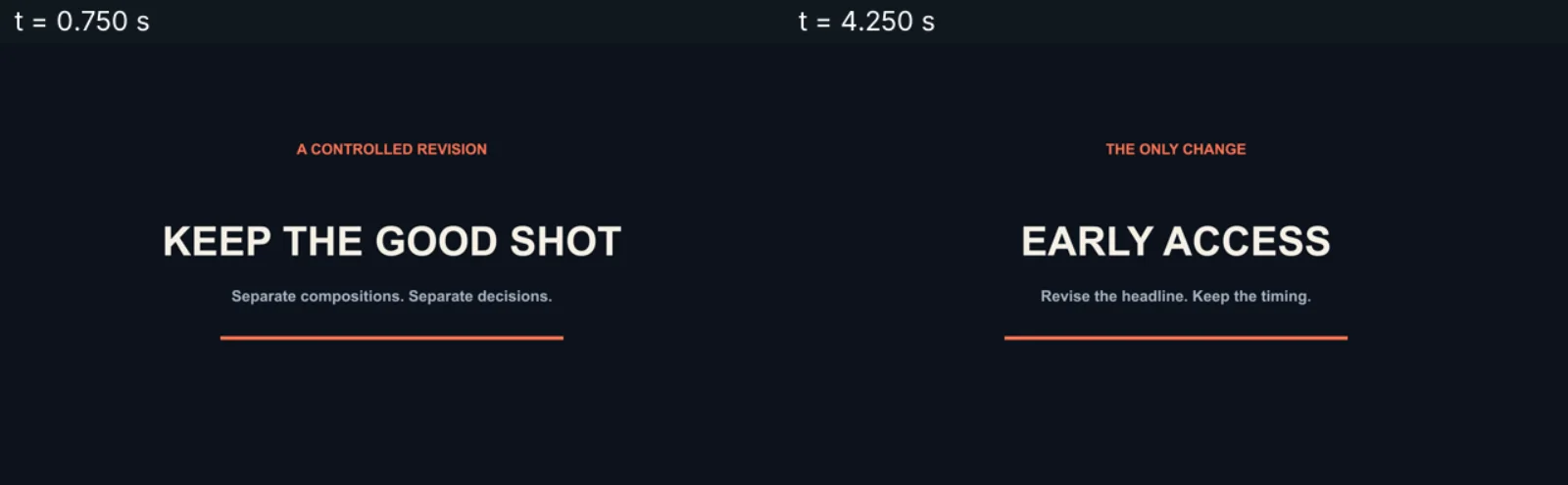
We changed one Source Text value, saved a second .aep and rendered the same two times. The first-shot PNGs were byte-identical. The end-card frame showed the new text; the master remained six seconds with two composition layers.
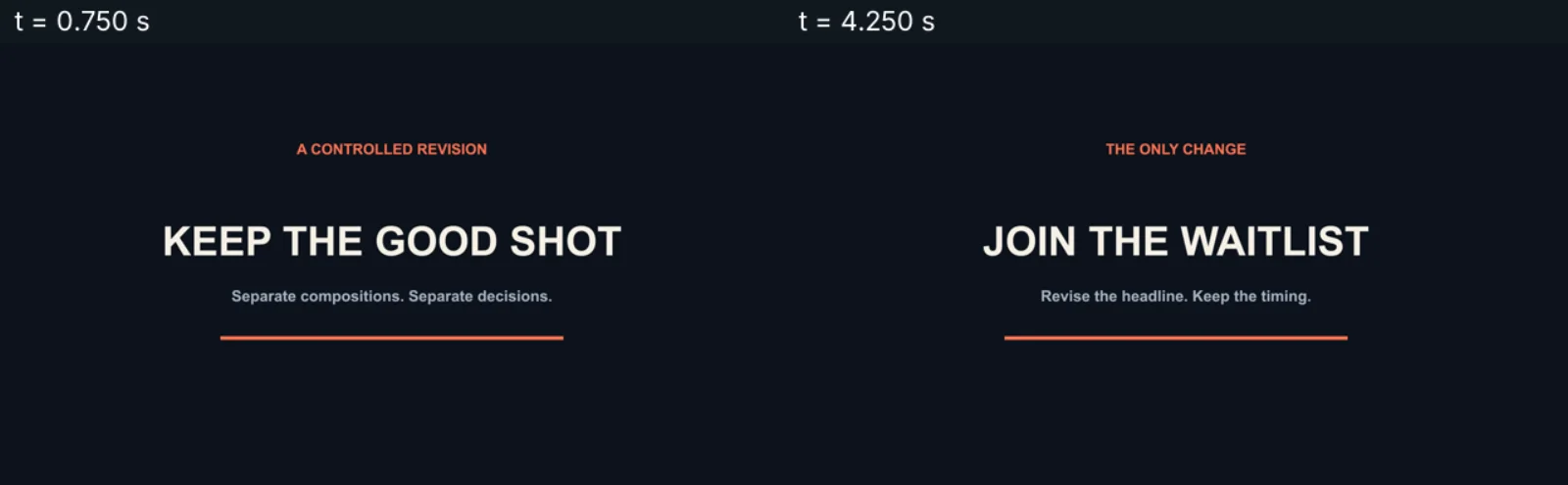
Download the original and revised After Effects projects. They use text and solids, with no external footage or third-party effects. This is a simple source-editing test, not a generative-video benchmark, audio test or verification of every frame. Its point is that the headline remains an addressable text layer, so revising it does not require synthesizing the picture again.
What an editable project keeps
Reverse the list. An editable AI video project keeps:
- Shots as separate clips, each with the prompt, the references and the model that produced it, so one can be redone without touching the rest. Which of those inputs a shot depends on is covered in text-to-video vs image-to-video.
- The timeline: order, in and out points, durations, and the decisions behind them.
- Layers: captions as text, overlays, the logo, so any of them can change without re-rendering the footage under it.
- Audio as stems: voice, music and sound design separate, so a line can be swapped without regenerating the bed.
- The brief, script and shot list as data, so a change to the plan can flow back into the cut instead of being re-typed into a prompt.
With those pieces preserved, changing a line can be a targeted audio edit. A vertical version can reuse the cut, though cropping, repositioning titles or replacing a shot may still take work.
The existence of a shot-level fix is well established. LTX's retake system regenerates a time window inside a clip and states that "content outside the time window is preserved exactly as it was in the original", with video and audio regenerable independently (LTX). Runway's Aleph 2.0 does "localized edits with precise input video preservation" (Runway). HeyGen re-renders only the avatar scenes whose script, voice or avatar changed (HeyGen). The capability exists. Whether a given tool keeps enough of the project around to use it is the thing to check.
Four questions to ask any tool
Each one has a check you can do from the export menu or the docs, without generating anything.
1. Can I change one shot without regenerating the others?
Two very different things get sold under this heading. One is editing the pixels of a rendered clip in place: replace an object, extend the ending, adjust the lighting. Runway's Aleph and Luma's Modify work this way. The other is re-rolling a shot from its own prompt and references inside a persistent timeline, while every other clip stays byte-identical. LTX's retake, OpenArt's Director, which says it "redoes exactly that, nothing more" when you give feedback on a shot (OpenArt), and HeyGen's per-scene re-render work this second way.
The check: after generation, does the tool still know each shot's prompt and references, or only its pixels? If the shot plan disappears once the video exists, as Kling's own post-production guide implies when it sends users to Premiere or Resolve for anything after generation (Kling), you have a generator, not a project.
2. Can I re-cut to another aspect ratio without a new brief?
There are three mechanisms behind any "reframe" button, and they are not equivalent.
| Mechanism | What happens | Cost | Audio |
|---|---|---|---|
| Reframe existing frames | Crops and repositions the frame you already have, tracking the action. Premiere's Auto Reframe is the standard example. | None | Kept |
| Generative outpaint | Invents new pixels beyond the original frame. Luma's Reframe and Envato's VideoGen Reframe work this way (Luma, Envato). Runway's expansion generates "new areas around your input video" (Runway changelog). | Credits | Sometimes dropped. Luma states reframed videos "are visual only" |
| Regenerate | Runs the shot plan again at the new ratio | A full run | New |
The check: ask whether the tool crops existing pixels, synthesizes new edges or regenerates the shot. Then check audio, source preservation and cost separately. Pricing alone does not reveal the mechanism.
3. Can a person open this in an editor they already use?
Somebody on your team finishes video in Premiere, Resolve, Final Cut or CapCut. The question is whether they receive the original layers and edit decisions or a flattened clip they must work around.
The check is the export menu. Look for a timeline format alongside the video: Premiere XML, FCPXML, EDL, OTIO, a native .prproj or .drp, plus a media folder, captions as an SRT file and audio stems. Adobe's own note on OTIO support describes what such a file carries: the cut list with clips in position, source in and out points, multiple tracks and markers (Adobe).
What the current field looks like, from each vendor's own documentation:
| Tool | Documented handoff |
|---|---|
| LTX Desktop | XML timelines in and out for Premiere, Resolve and Final Cut; H.264 and ProRes; SRT in and out (LTX) |
| Descript | Premiere XML, FCPXML, EDL, AAF and more, with media and timecode; on paid plans (Descript) |
| Runway | ProRes 4444 with PCM audio, or a PNG sequence, per the August 2026 changelog. A render, not a project. A Premiere and After Effects panel places results into a sequence (Runway changelog) |
| HeyGen | MP4 at plan-dependent resolution, audio only, an SRT captions file (HeyGen) |
| CapCut | Video only to other apps. Its help centre states it "does not support direct importing or exporting of project files from third-party editing software" (CapCut) |
| Kling, Luma, Google Flow | Downloadable clips. No project export documented |
A ProRes file is a high-quality render. It is still a render. If only footage leaves the tool, revisions to its original layers and generation settings depend on returning to the tool. Ordinary editing of the exported footage remains possible elsewhere.
4. Will it still open next year?
Most AI video projects live on the vendor's servers. The project is a URL. That is fine until the plan changes, the product pivots, or the tool retires a model, which happens regularly: Runway retired Gen-3 Alpha in July 2026 and Google deprecated Veo 3 in favour of 3.1 within the same year. Retained footage remains editable after a model retires. What disappears is the ability to reproduce or vary it through that exact model, so download the approved media as well as the prompts.
The check: is there a file on disk that describes the project? The most durable form is structured source. Remotion projects are code with JSON properties (Remotion); HyperFrames compositions are an HTML file that renders the same frames every time (HyperFrames); an OTIO or XML export with a media folder is the editor-native equivalent. Keep the media, fonts, plugins and runtime versions those sources require. A file on disk improves portability; it does not remove dependencies or guarantee that a project will reopen unchanged.
A fifth question, if you use an agent
Is the brief part of the project? An agent works from a plan: the job, the shot list, the references, the script. If that plan is stored as data alongside the cut, a change to the plan can be re-run as a change to the cut. If the plan lives only in a chat, the editor or next agent may have to reconstruct which instructions produced each shot. What that plan should contain is the subject of how to brief an AI video agent. HeyGen keeps the script per scene as the editable source; Remotion keeps the plan as properties; Kling's multi-shot plan exists at generation time and is not documented as re-editable afterwards (Kling). For agent-driven work, this is the question that decides whether revisions get cheaper over time or stay as expensive as the first run.
Where Voyager stands
We hold our own output to the four questions above, and we are in private preview, so the honest statement is about intent and current shape rather than a finished spec. Everything Voyager makes is meant to come back as a project: shots as clips with their prompts and references, a timeline, captions and audio as separate layers, and the brief and shot list stored with the cut. Which export formats ship at launch, and exactly how a reframe is performed, are the things to ask us about directly rather than assume from this post. If a specific interchange format matters to your team, tell us which one.
Frequently asked questions
Can I edit an AI-generated video after it is made, or do I have to regenerate everything? It depends on whether the tool kept a project or only a file. Tools with a persistent timeline and shot-level retake, such as LTX, OpenArt's Director and HeyGen's scene-based studio, can redo one shot and leave the rest untouched. An exported clip can still be cut, cropped or patched in an editor. Revisions that depend on missing text layers, stems or generation settings take more reconstruction and may require regenerating a section.
How do I change an AI video from 16:9 to 9:16, and will the audio survive? Three ways: reframe the existing frames in an editor, which keeps audio and costs nothing; generative outpaint, which invents new picture and may drop audio; or regenerate at the new ratio. Check which one a tool does before relying on it. Luma's Reframe, for example, documents that its output is visual only.
Can I open a Runway, Kling or Veo video in Premiere or Resolve as a project? As a clip, yes. As a project, not from those tools' documented exports as of September 2026. Runway exports ProRes or PNG sequences and offers a panel that places clips into a sequence; Kling and Flow provide downloadable video. For a project handoff you need a tool that exports XML, EDL or OTIO with media, such as LTX Desktop or Descript.
What is an OTIO or XML file, and why would I want one from an AI tool? A timeline interchange file: a description of which clips go where, with in and out points, tracks and markers, referencing media files kept separately. It is what lets an editor open your cut and keep working instead of starting from footage. OTIO is the open standard; Premiere XML, FCPXML and EDL are older equivalents.
Which tools keep the script and shot list editable? HeyGen stores the script per scene and re-renders only what changed. Descript treats the transcript as the edit. Code-based tools like Remotion and HyperFrames keep the whole plan as source. Among hosted generators, this is the least documented capability, so ask before you assume.
Make your next project in Voyager
Create an account, download Voyager, and start making.