
A useful video brief tells the agent what the video must achieve, who will watch it, what it must preserve and how you will judge the result. A shot prompt describes one piece of that job. If you want an agent to plan and assemble a cut, give it enough context to choose those pieces.
You do not need a long production document. Start with the template below, attach the approved assets, and review the proposed shot list before generation.
Jump to: copyable template · the four decisions · worked example · revision diagnosis
Copy this brief
Job: Make [deliverable] for [placement], so the viewer [desired action].
Viewer: [Who they are, what they know, and whether sound is likely on].
Assets: Use [attached files]. Preserve [product, face, logo, exact wording].
Constraints: [Duration, aspect ratio, language, must-include and must-avoid].
Audio: [Exact script or freedom to draft, voice direction, music constraints].
Handoff: [Rendered video, editable project, captions, audio stems].
Done means: [Three observable checks that determine acceptance].
Before generating: Show the shot plan and flag any unsupported requirement.
Replace the brackets and remove fields that do not matter. If a detail is undecided, say so rather than letting a placeholder become a production instruction.
A prompt is a shot. A brief is a job.
Many model prompt guides focus on the ingredients of a shot. Runway's guide recommends [Camera] shot of [subject] [action] in [environment], with supporting descriptions after (Runway Academy). Kling's is Subject + Movement + Scene, then camera, lighting and atmosphere (Kling). Google's Veo guidance lists subject, action, style, camera positioning and motion, composition, focus and ambiance (Gemini API docs). OpenAI's Sora 2 guide puts it well: prompting is like "briefing a cinematographer who has never seen your storyboard" (OpenAI cookbook).
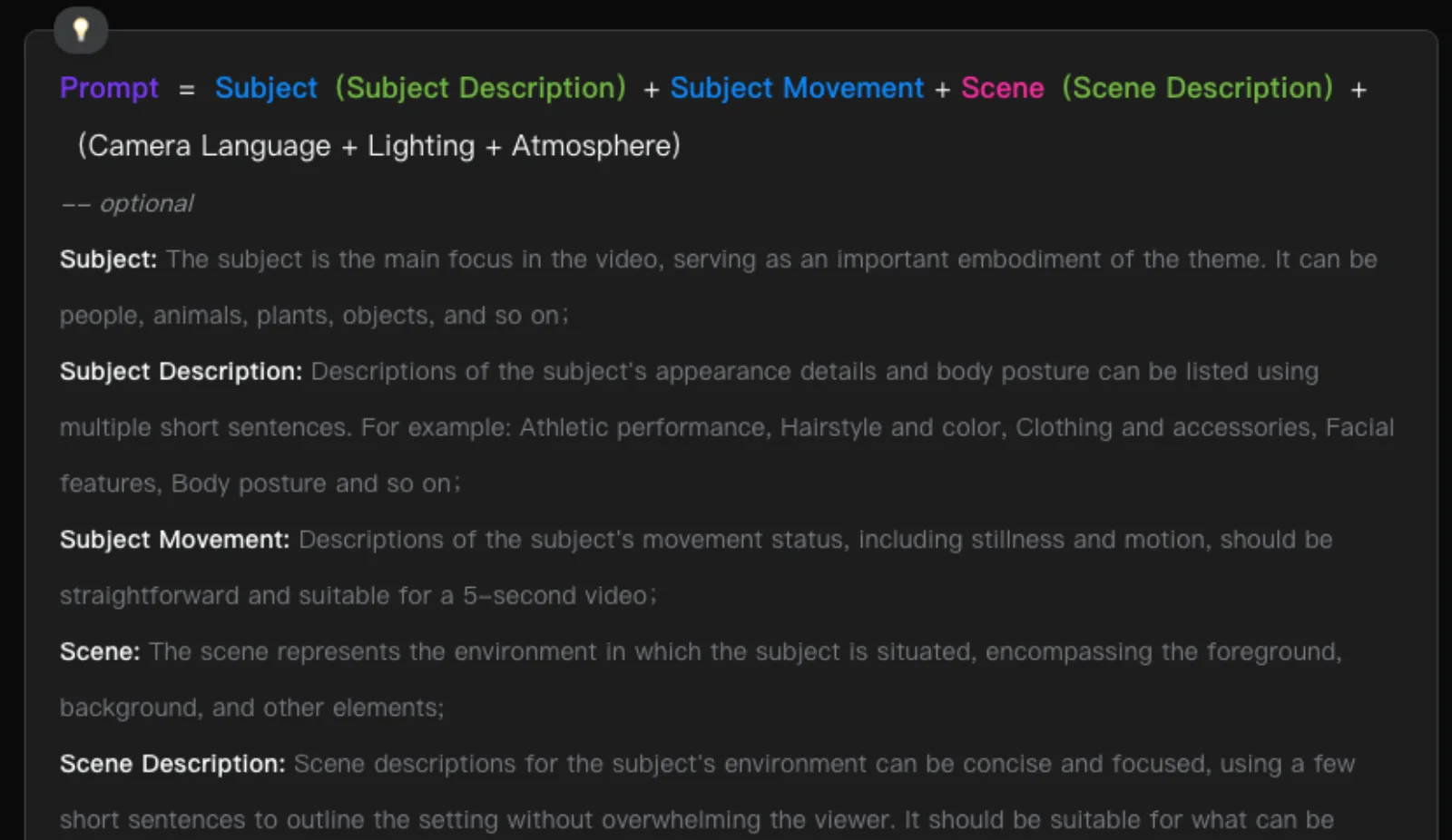
That is the right analogy, and it exposes the gap. A cinematographer still needs to know what the film is for. The formulas above are what an agent writes, one per shot, after it has decided what the shots are. What you write is the layer above: the reason the video exists, who it is for, what it may and may not do, and how you will judge it.
A traditional creative brief sits at that layer, but it was written for a production company with a two-week schedule: a page or two covering objective, audience, competition, budget, mood boards, deadlines and deliverables. An agent still needs budget, deadline or approval constraints when they affect the work. The four decisions below organize that information without requiring a long document.
Here is the same idea as a prompt and as a brief, so the difference is concrete.
Prompt: Slow dolly-in on a matte black smartwatch on a concrete plinth, soft top light, shallow depth of field, 5 seconds.
Brief: A 20-second vertical teaser for the Series 3 watch, for people who already own the Series 2 and are deciding whether to upgrade. The one thing they need to see is the new always-on display next to the old one. Use the two product renders attached; do not invent a watch. No music with vocals. Done means a cut where the display comparison is the longest shot and the last frame is the pre-order date.
The prompt gets you a nice shot of a watch. The brief gets you a plan you can approve or correct before anything renders.
1. The job
What the video has to do, and where it will run. One outcome, one placement.
"Announce the launch" is not a job. "Get existing customers to pre-order the upgrade" is. A single outcome tells the agent what the longest shot should be and what the last frame should say. When a brief carries three outcomes, the cut serves none of them, and the fix is to split it into three videos.
Placement sets the target aspect ratio, duration and viewing conditions. Keep the finished-video requirement separate from model limits: a 20-second deliverable might use several shorter generations. Let the agent check the selected model's supported lengths before proposing the shot plan.
Name the approved assets here too. If a real product must appear, attach the renders and specify which details cannot change. References improve the model's information; they do not guarantee identity or exact text throughout a moving shot. The choice of input for each shot is covered in text-to-video vs image-to-video.
2. The viewer
Who is watching, and what they already believe.
"Everyone" produces the average of everything. It is the most common failure in briefs written by people who know the product too well. The upgrade teaser above works because the viewer already owns the old model. The same product briefed for someone who has never heard of it needs a different first shot, a different pace and probably a different length.
Two questions do most of the work. Where are they when they see it? That sets sound-on or sound-off, which decides whether the message lives in the voiceover or in the frame. And what do they already know? That decides what you can skip. A viewer who knows the category does not need the problem explained; a viewer who does not will not sit through a feature list.
Write the viewer as a person in a situation, not a demographic. "A Series 2 owner scrolling with sound off, who has seen the launch headline and is deciding whether it is worth it" gives the agent a hook, a format and a reason to put the comparison up front. "Tech-savvy consumers 25 to 45" gives it nothing.
3. The constraints
Two kinds, and they behave differently.
Hard constraints are facts the cut must obey: total length, aspect ratio, the assets that must appear, brand rules, claims that cannot be made, the deadline, and the budget in credits or minutes if that matters. List them plainly. An agent can plan around a hard constraint it knows about and cannot plan around one it discovers on a revision.
Taste constraints are direction: tone, pace, references, and what to avoid. These are where most briefs go wrong, in two ways.
The first is negatives. Every vendor guide says the same thing about prompts: describe what you want, not what you do not. Runway's guidance is explicit, and Google's Veo guide tells you to state the positive condition instead of naming the thing to exclude (Runway Academy, Google Cloud Veo guide). That is a prompt-level fact about how models read text. Your brief is the right place for "never show the watch on a wrist" precisely because the agent, not the model, reads the brief. It translates the rule into positive shot descriptions. So put your negatives in the brief, and keep them out of anything that goes to a model directly.
The second is reference overload. Ten mood-board images with no hierarchy tell the agent nothing about which one wins when they conflict. Two references and a sentence about what each one is for ("this for the pace, this for the colour") beats a folder.
A useful split for what to generate versus what to reuse:
| Reuse from your assets | Let the agent generate |
|---|---|
| The product, from renders or photos | Environments and backgrounds |
| Faces of real people | Abstract motion, transitions, texture |
| Logos, type, on-screen copy | Camera moves around your assets |
| Existing footage you own | Music beds and sound design |
| Claims and numbers, verbatim | Pacing and shot order |
Anything in the left column that the agent invents is a mistake you will catch on review, so say up front that it is fixed.
4. What done looks like
This is the part a traditional brief handles worst, and it is the part that makes an agent run correctable. Where a conventional brief has success metrics at all, they are post-publish numbers like views and conversions. For an agent, done means the first cut you will accept without a second run. Write the acceptance test before the run, in three lines:
- The one shot that must exist. The display comparison, held long enough to read.
- The one thing a viewer should be able to say afterwards. "The new screen stays on."
- The delivery. 20 seconds, 9:16, captions burned in, last frame is the date.
Three lines is enough to judge the plan. When the agent returns its shot list, you check it against the test, not against your taste in the moment. If the must-exist shot is four seconds in a twenty-second cut, you can say so before a frame renders. That is the cheapest correction there is, and it is only possible because you wrote down what done looks like.
The published workflow that comes closest to this is ngram's: the brief carries an audience, a single promise, proof, a narrative arc and constraints, and the agent returns a one-line objective and a six-scene plan for approval before anything is rendered (ngram). The approval gate is the point. A plan is cheap to change. A render is not.
A worked brief
The whole thing, for a small product, in under 200 words.
Job. A 30-second vertical teaser for Pocket, a receipts app for freelancers, to run as a paid placement on Instagram Reels. Outcome: taps to the App Store listing.
Viewer. A freelancer scrolling with sound off who has just spent a Sunday doing expenses. They know the pain. They do not know Pocket exists.
Constraints. Use the two attached app screenshots for any UI; do not invent screens. The brand green is #1F7A4D. No people's faces. Captions burned in, since sound is off. The only claim allowed: "scan a receipt in one tap". Reference: the pace of the attached 15-second clip, not its look.
Done. The must-exist shot is a receipt being scanned and appearing in the app, at least six seconds. A viewer should be able to say "it scans receipts for me". 30 seconds, 9:16, ends on the app icon and the line "Free on iOS".
A plan that comes back from a brief like this looks something like: hook on the Sunday pile of receipts (3 seconds), the one-tap scan (7 seconds, the must-exist shot, built from the first screenshot), the result in the app (5 seconds, second screenshot), a short montage of receipts becoming rows (8 seconds), and the close (7 seconds). You read that against the three lines under Done and either approve it or send one correction.
When the first cut is wrong
There are three kinds of correction, and they cost very different amounts. Knowing which one you need is most of the skill.
Correct the plan. Before generation. The shot list is wrong, the order is wrong, the must-exist shot is too short. This is a sentence, and it costs nothing. It is available only if the agent shows you the plan first, which is the thing to look for in any agent you consider.
Correct a shot. After generation. One clip missed: the product drifted, the camera revealed something off-frame, the lighting fought the reference. Models are stateless between generations and hold identity through reference inputs, not prose, so a single shot can go wrong while the rest is fine. Regenerate that shot, with a tighter reference if identity was the problem, and keep everything else. If a tool cannot do this without re-rolling the whole cut, the second revision costs as much as the first. Whether it can is the first of the four questions to ask any tool before you commit a project to it.
Correct the brief. Something was missing, and every shot shows it. The viewer was wrong, the outcome was vague, or a hard constraint never got written down. Re-plan before generating more. Reuse any shots that still meet the revised brief; a changed brief does not automatically make all existing footage unusable.
The pattern to watch for: if you find yourself correcting shot after shot for the same reason, stop. That is a brief problem wearing a shot problem's clothes.
Where Voyager fits, and where it does not
Voyager is built for exactly this shape of work: you give it a brief, it plans the shots, explains the plan in plain language, and lets you redirect before and during the run. It is in private preview, so treat that as the intended shape rather than a finished product, and check the current behaviour against your own job before relying on it.
If what you need is one beautiful shot, a brief is overhead and a prompt into a model you like is the faster route. The four parts earn their keep when the deliverable is a cut, with several shots, a message and a place it has to run.
Frequently asked questions
What is the difference between a prompt and a brief? A prompt describes what one shot looks like and goes to a model. A brief describes why the video exists, who it is for, what it must and must not do, and what a finished cut looks like, and goes to an agent, which writes the prompts. A shot description alone usually omits the audience, delivery constraints and acceptance criteria for the finished cut.
How long should a brief be? As long as it takes to state the job, the viewer, the constraints and the acceptance test, and no longer. The worked example above is under 200 words. A traditional brief runs one to two pages because it is written for a crew and a schedule. Length is not the measure; whether the agent can plan from it is.
How do I keep the same product or character across scenes? With reference inputs, not descriptions. Attach the renders or photos and say they are fixed. Supported reference counts vary by model and mode. Check each generated shot against the approved assets; references help with identity but do not guarantee it.
Should I write the shot list myself or let the agent plan it? Let the agent plan it, then check the plan against your Done lines. If you already have a script or a shot list, give it as a reference and say which parts are fixed. A fixed shot list is useful when the creative direction is already approved. The agent can still assemble, execute and check it; include acceptance criteria either way.
Why did the agent ignore part of my brief? Usually one of three things: two constraints conflicted and it picked one, a negative rule was ambiguous, or too many references pulled in different directions. Read the plan it returned, find the line where it diverged, and correct that line rather than the output.
Can I give the agent a script instead of a brief? Yes, and it helps. A script still needs the job and the viewer around it, though. A script tells the agent what is said; it does not tell it where the video runs, who is watching, or what shot must exist for the cut to count as done.
Make your next project in Voyager
Create an account, download Voyager, and start making.